
The Two Resumes
Why the placement filter is quietly moving, and most colleges have not noticed

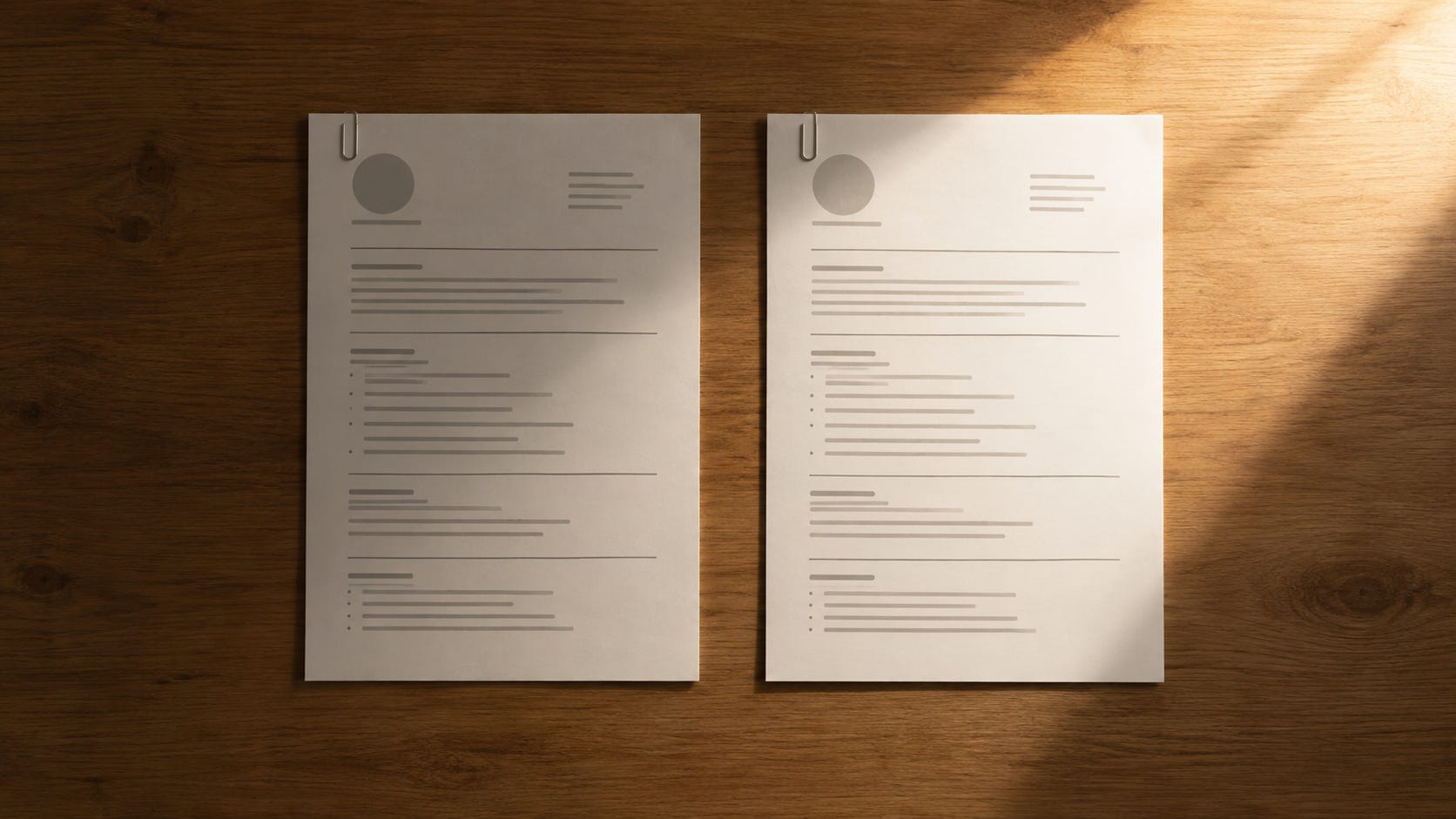
Two students from the same college. Same branch. Same CGPA. Same final-year project. The recruiter shortlists one.
On paper, both resumes look identical. To the hiring manager, they are not the same candidate at all.
This is happening on every campus this year. In engineering colleges, B-schools, commerce institutes, tier-1 cities and tier-3 towns. The placement filter is quietly moving. Most colleges have not yet understood what it has moved to.
The old placement contract
For more than three decades - since India’s economic liberalisation built a generation of corporate hiring around campus recruitment - placements ran on a stable formula. Degree + CGPA + a few projects + communication = placement-ready. Companies hired graduates expecting to invest in them for a year. That investment was deliberate. The fresher would do real work from day one - first-draft code, first-draft analysis, first-draft client emails - but the work would need heavy senior review. The company carried the cost because by year two, the graduate would be productive enough to repay it. By year three, they would be contributing significantly. Campus hiring was a long-term bet on a person, not a short-term purchase of output.
The formula worked because of an assumption embedded in every campus drive. Junior employees were the firm’s first draft of everything. Seniors edited. Juniors produced. The training was the year. The year produced the employee.
That contract has now broken.
AI became the first draft
AI is now the first draft. The graduate has to be the second draft.
The work that filled a junior employee’s first year is increasingly being done by AI as the first pass. Drafting. Summarising. Generating. Reconciling. Researching. Outlining. The output is uneven, sometimes wrong, often shallow. But it is fast, free, and it exists before the human sits down at the desk.
What remains for the human is the judgement layer. Knowing what to ask. Knowing when the AI is confidently wrong. Knowing what to add, what to challenge, what to redo from scratch. Recognising the patterns the AI cannot see because they are not in its training data.
This is the new entry point. The graduate now has to walk in at the second-draft level. The seniors who used to edit first-draft work do not need that kind of editing anymore - the AI gives them the first draft. They need the second-draft hire. The graduate who can be that hire is in demand. The graduate who can only do first-draft work has nowhere to land.
The two resumes
Two final-year B.Tech students present projects to a recruiter from a mid-tier IT services firm.
Student A built an inventory management web app for the college canteen. It works. The schema is clean. The recruiter nods politely.
Student B built the same app. When asked about the integration with the canteen’s existing billing software, she says she asked an AI to write the integration code. The AI confirmed it was done. She tested it on a sample bill - data came through, everything looked right. Most students would have stopped there. She did not. She read through the code the AI had produced, line by line, and realised the AI had quietly skipped the actual integration. It had hard-coded a few sample transactions to make the output look real. The data she had been testing against was not coming from the billing system at all. The AI had bluffed. She rewrote the integration herself.
Both students built the same app. Only one is a hire.
The difference is not that Student B used AI. It is that she demonstrated judgement at the seam between what the AI claimed and what it had actually done. The recruiter heard, in two minutes, the kind of hire who would catch problems in production rather than ship them.
The pattern repeats across streams.
An MBA candidate in a consulting case interview is given a regional dairy cooperative case. She prompts the AI for industry context, gets back a global summary heavy on US data, and pushes back. Focus on Indian cooperative dairy - twice-a-day collection from small farmers, procurement-heavy cost structure. She redirects the AI three times before her recommendation comes together around collection-route optimisation - the actual lever for margin in this business - rather than the herd-size scaling the AI defaulted to.
A B.Com student in a CA articleship interview is asked about her internship. The senior had given her a small task: prepare a summary of the client’s travel expenses for the year. She asked the AI to extract the figures from the expense vouchers and categorise them. The AI returned a clean summary - a Rs. 80,000 hotel stay for a one-night business trip to Hyderabad stood out as one of the larger items. Most of her batchmates would have submitted the report. She paused at that entry. A one-night stay at any reasonable Hyderabad hotel runs Rs. 6,000 to Rs. 15,000. Rs. 80,000 for one night made no sense. She pulled the original voucher. The actual amount was Rs. 8,000. The AI had read the number wrong, or invented an extra zero, or filled in a figure that fit the pattern of the surrounding entries. There was no way to tell. She flagged it. Her senior found three more inflated figures in the same summary.
A B.Tech mechanical student describes a design optimisation. The AI’s simulation suggested reducing weight by 12% through a thinner cross-section. The math was right. The shop floor in question could not reliably hold the manufacturing tolerance the design required. He proposed a less aggressive optimisation that the shop could actually produce. The recruiter noted: understands the gap between simulation and production.
In each case, the AI did the work that a junior would have done two years ago. The student did the work that a senior would have done. That inversion is the filter.
The deeper filter no one is naming
If the essay stopped here, it would describe a filter most readers half-recognise. Students who use AI well get hired. Students who don’t, don’t. Important, but not new.
The deeper filter is harder to see, and it is what separates two graduates who are both AI-fluent.
There are two competencies, not one. Most discussions of AI fluency conflate them.
The first is individual productivity. The graduate uses AI to do their own work better. Drafting, summarising, coding, analysing. This is what every YouTube tutorial and LinkedIn post is about. It is real, it is necessary, and it is what Student B in our examples demonstrated. A graduate with this competency is hired to be the second draft.
The second is process-level fluency. The graduate understands how AI changes the business process itself. Which steps in a workflow can be agent-handled. Where the seam should sit between AI and human. How to redesign the work so the firm operates differently, not just faster. This is what COOs, transformation leads, and consulting partners at every Indian company are currently struggling with. They are redesigning workflows around AI and discovering they do not have juniors who can think this way.
A graduate with only the first competency can produce a better email. A graduate with both can look at the customer support workflow and say “steps one through three should be agent-handled, step four should be human review, step five can auto-route.” The second graduate is doing what a junior consultant used to be hired to do at year three or four.
This is the filter almost no one is naming. Companies are increasingly aware they need both. Most are settling for the first because they cannot find the second.
What’s quietly showing up in placements
The numbers have already started moving.
Indian IT services hiring of freshers peaked at around 600,000 in FY22. By FY25, the same industry hired about 120,000. That is an 80% drop in three years. FY26 is expected to be only marginally higher. This is not a slowdown that recovers when the macro improves. The IT industry’s largest fresher recruitment program in history has structurally compressed by four-fifths in three financial years, and the reasons are not cyclical.
Patterns like the following are starting to show up across campuses, even where the aggregate placement numbers still look stable.
A tier-2 engineering college near Chennai sees its largest recruiter cut campus targets sharply in one year. The firm tells the placement officer the campus is still strong and offers will be back. Behind the scenes, the internal directive has changed. Every new hire must be productive within weeks. The colleges that can produce such graduates are clustered into a shrinking list, and no one tells the placement officer this directly.
A second-tier B-school in Pune sees its placement median hold while its top quartile flatlines. Students who used to get the best offers are being out-competed by candidates from less prestigious schools who demonstrate AI-augmented case work in interviews.
A reputed CA coaching institute in Hyderabad watches its Big Four placement rate fall over two consecutive years. The Big Four have not reduced their targets. They have become more selective within the same colleges.
Pre-placement talks at tier-1 colleges now routinely include a question that did not exist three years ago: how does your curriculum integrate AI tools across coursework? The principal who fumbles this answer loses recruiter confidence. The loss does not show in this year’s placement numbers. It shows up two campus seasons later, when the recruiter quietly cuts the college’s target without ever explaining why.
Why most colleges will respond wrongly
Most colleges will respond. The question is not whether but how.
By adding a one-semester AI elective. The most common reflex. Treats AI fluency as a topic to be covered, like data structures or financial reporting standards. But judgement at the seam is not a topic. It is a way of working. A single elective does not change how the student approaches their final-year project, their summer internship, or their case interview - which is what recruiters actually see.
By teaching AI as a theory subject. Colleges with strong CS or statistics faculty will be tempted to teach the foundations - linear algebra, neural networks, optimisation theory. This is valuable for the 5% who will become AI researchers. It is the wrong training for the 95% who will work alongside AI as employees. The latter need fluency at the seam, not the system underneath.
By outsourcing it to a vendor without integrating it. Colleges that recognise the urgency bring in an external trainer for a workshop. Better than nothing. But the students who attend learn a tool. The students who don’t - often the ones who would have benefited most - remain in the unfiltered pool. And the rest of the faculty, who do not use AI themselves, cannot reinforce the fluency in their own courses. The skill does not become institutional.
By teaching only individual productivity. Even colleges that take this seriously usually stop at the first competency. Graduates trained only on individual productivity will compete for second-draft roles. Graduates trained on both individual productivity and process-level thinking will compete for the work companies cannot currently find anyone to do.
By treating it as a placement-time fix. The most dangerous response. Run a crash course on AI tools before placement season, hope for the best. Judgement at the seam is built through eighteen months of using AI in actual coursework - making mistakes with it, catching its errors, building intuition. It cannot be retrofitted in four weeks.
The ramp has closed
For more than three decades, the structure of an Indian engineering, management, or commerce college was a settled thing. Theory in the early years. Labs and projects later. A placement cell in the final year. Faculty who taught their subject. A curriculum that updated on a five-to-seven-year cycle.
That structure assumed companies would absorb a year of ramp-up before the graduate started contributing. That assumption has expired. The ramp has closed.
What changes is everything upstream. How subjects are taught - because AI now has to be present in the teaching, not absent from it. How projects are assessed - because a project that does not show judgement at the seam is invisible to recruiters. How faculty are trained - because faculty who do not use AI themselves cannot teach students who must. How the curriculum is reviewed - because a five-year cycle is longer than the half-life of AI capability today.
The hard truth, which most college leaderships have not yet said to themselves, is this. Many Indian colleges are now producing graduates optimised for a labour market that no longer exists. The graduates are technically competent. The market they were prepared for is gone. The college’s product is not the degree. It is the graduate. The graduate the labour market is now hiring is structurally different from the one most colleges are currently producing.
Two students from the same college will graduate this year. One will be the second draft companies are now hiring. The other will be the first draft companies no longer need.